
We've all been there. You're in a massive airport terminal, a sprawling hospital, or a convention centre the size of a small town. You look up at a digital screen showing a flat map, try to mentally rotate it to match the direction you're facing, and immediately take the wrong turn.
That's the fundamental flaw with traditional wayfinding: it asks you to translate two-dimensional information into three-dimensional decisions. And most of the time, it doesn't work.
The global digital signage market hit $35.2 billion in 2026, growing at 8.2% annually. That's a lot of screens. But more screens doesn't mean better navigation. What's changing now is something far more interesting — signage that actually exists in three dimensions, responds to who you are, and meets you where you stand.
Here's what's driving that shift.
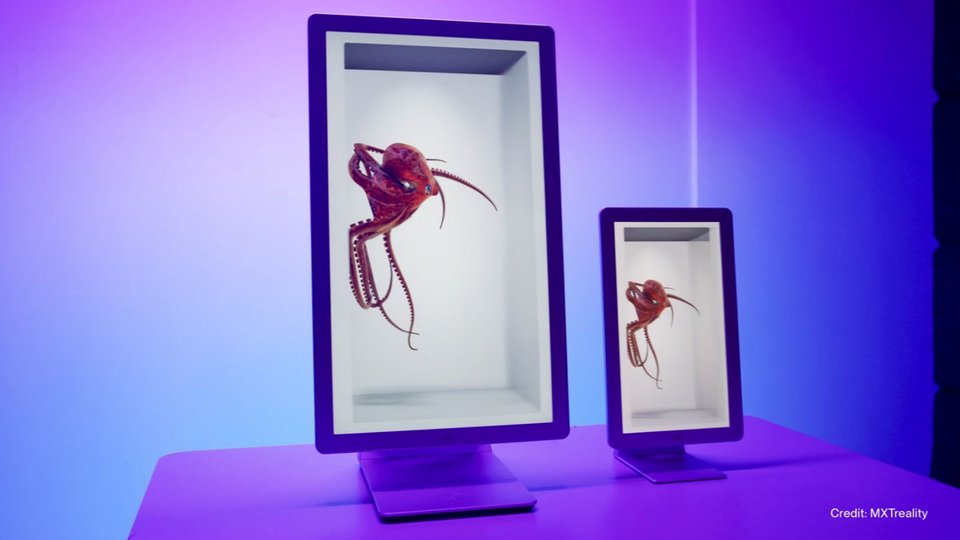
Looking Glass Factory's Hololuminescent Display (HLD) is one of the most compelling pieces of display hardware to emerge in years. It takes ordinary 2D video and transforms it into dimensional, holographic content — no 3D production pipeline, no special glasses, no dark room required.
What makes it practical for wayfinding:
For navigation, this changes everything. Instead of reading a flat floor plan and guessing which corridor to take, a visitor sees a three-dimensional model of the building where corridors recede into depth, floors stack vertically, and the route visually pulls you toward your destination.
Pricing and availability (2026):
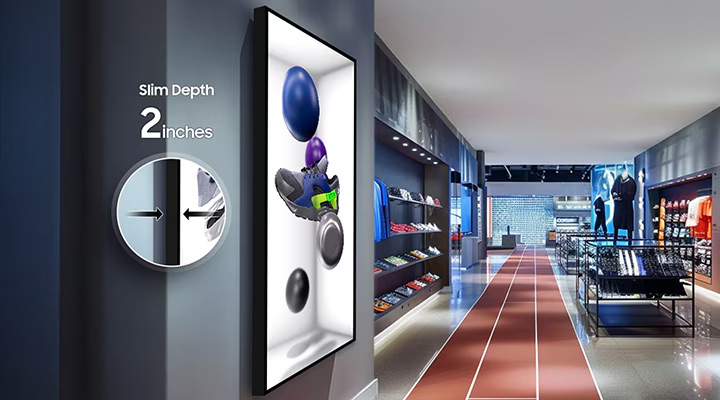
Samsung's SM85HX-P takes a complementary approach at commercial scale. This 85-inch display produces glasses-free 3D imagery where objects appear to extend up to 3.5 feet beyond the screen surface — despite the panel itself being only 2 inches deep.
The smart move Samsung made: existing 2D assets can be converted to 3D through their VXT cloud CMS. If you're already running a network of Samsung displays, the upgrade path from flat to spatial is incremental, not disruptive.
Research from the holographic advertising sector shows dimensional displays boost engagement by up to 60% compared to flat panels. In wayfinding, engagement equals comprehension — someone who stops and processes a 3D route is far more likely to navigate successfully than someone glancing at a flat map while walking past.
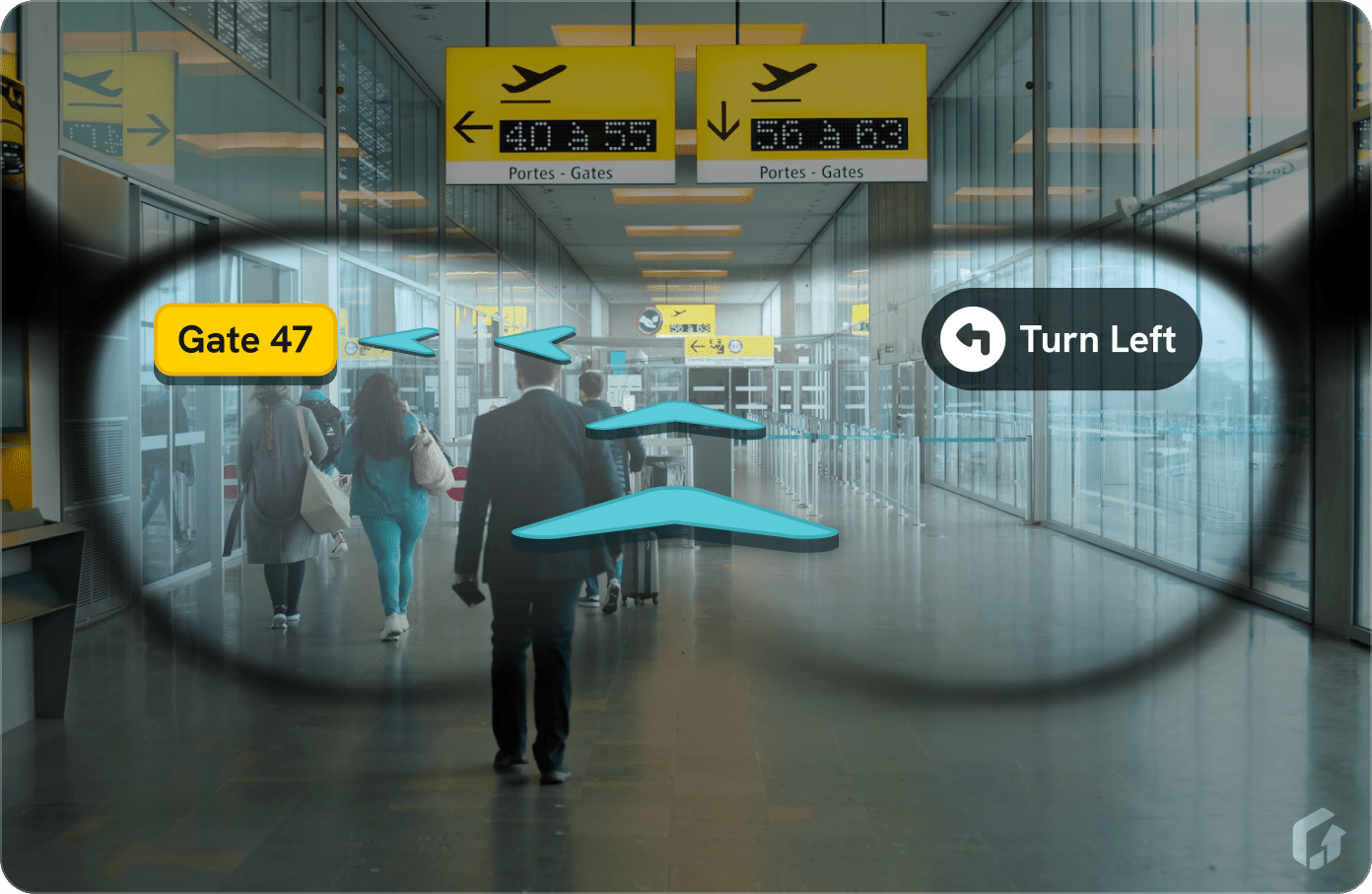
Holographic displays make fixed signage better. But they're still fixed — stuck on walls and pillars. The next layer moves with the visitor.
CES 2026 made it clear that smart glasses are approaching a real inflection point. IDC reported that the event revealed "how smart glasses are moving toward mass adoption, driven by gaming, AR optics breakthroughs, and maturing supply chains."
For wayfinding, the value proposition is simple:
RayNeo's 2026 smart glasses navigation system is a good example: heads-up turn-by-turn directions overlaid on the real world, with contextual POIs surfacing as you walk. For complex indoor environments — hospitals with multiple wings, convention centres during peak events — this is transformative.
The constraint is adoption. Not everyone owns AR glasses yet. Which brings us to the technology that bridges the gap.
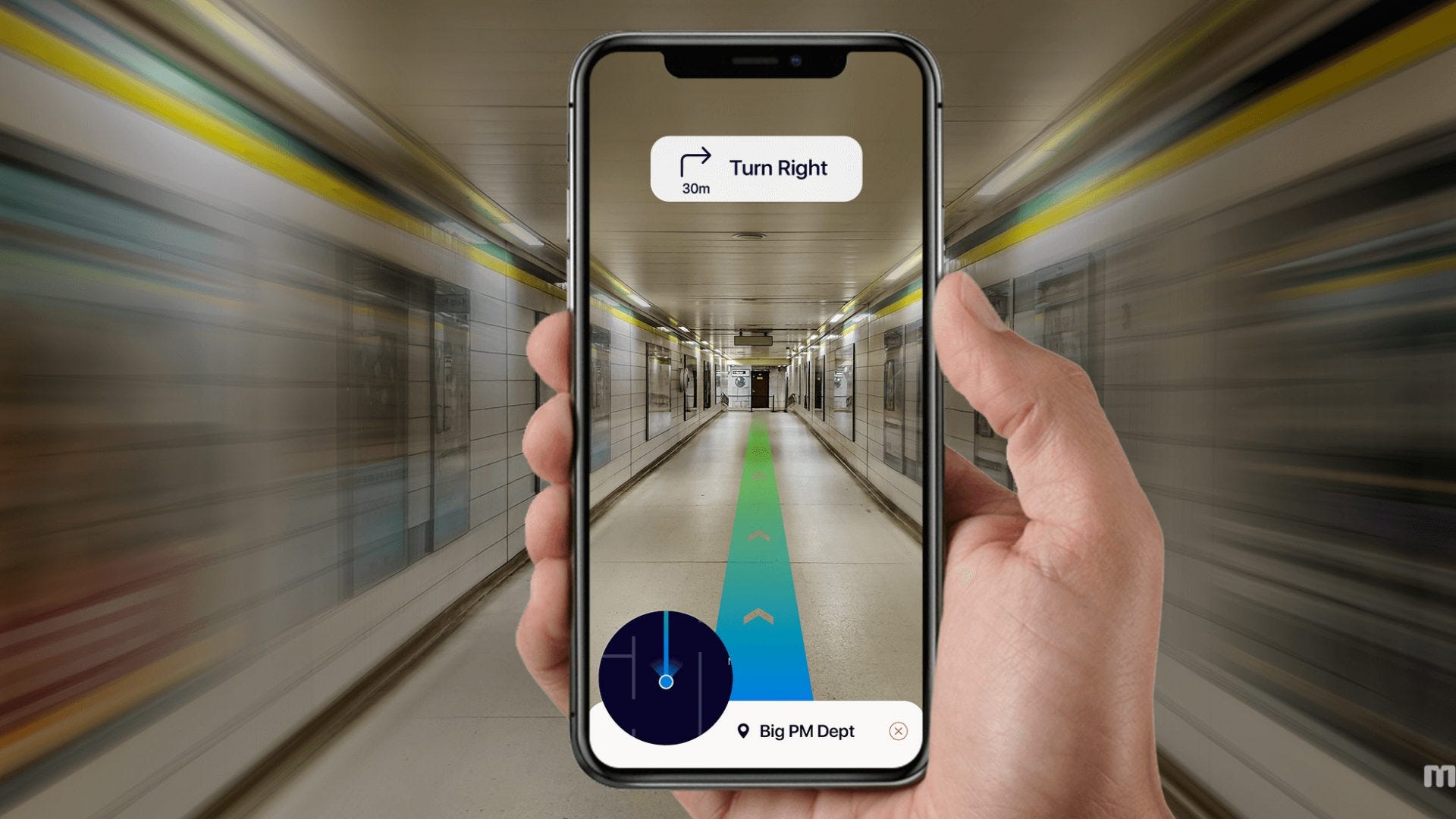
Web-based augmented reality — WebAR — delivers AR experiences directly through a mobile browser. No app download. No account creation. No friction.
The visitor scans a QR code, opens a URL, and their phone camera becomes an AR viewport overlaying directional cues, route markers, and information panels onto the live view of the space around them.
Why this matters for wayfinding:
Modern WebAR platforms like Kivicube now package hosting, spatial tracking, and analytics as integrated services. Deploying browser-based AR wayfinding is becoming as straightforward as managing a website.
The analytics angle is particularly powerful. With static signage, you have no idea whether anyone reads it. With WebAR, you know exactly how visitors navigate — data that can inform space planning, staffing, and commercial decisions.
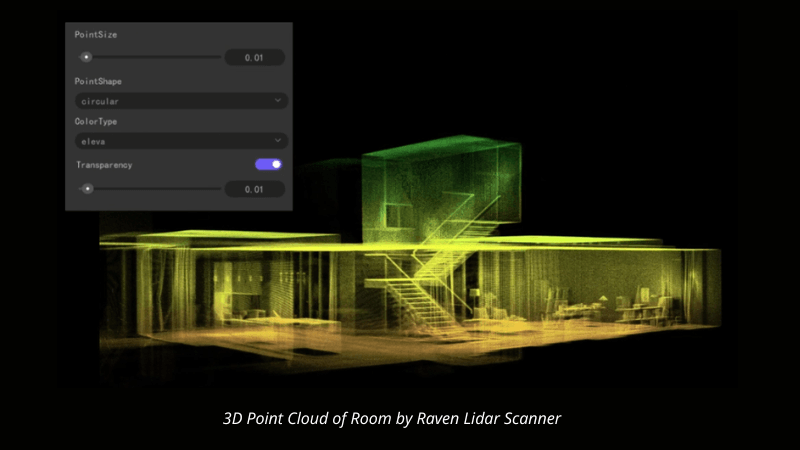
All of these visitor-facing technologies depend on something most visitors will never see: the LiDAR-scanned digital twin.
LiDAR (Light Detection and Ranging) scanning captures the three-dimensional geometry of interior spaces with centimetre-level precision. The resulting point cloud is processed into a digital twin — a geometrically accurate 3D model of the building that serves as the spatial reference for everything layered on top.
What the digital twin enables:
GoodMaps has demonstrated infrastructure-free indoor navigation built entirely on LiDAR-scanned digital twins — no Bluetooth beacons, no Wi-Fi fingerprinting, no hardware installed throughout the building. The digital twin itself becomes the positioning reference.
Matterport has made the scanning process accessible enough that facility teams can capture interior geometry using mobile devices with LiDAR sensors (recent iPhones and iPads). A hospital can rescan a renovated wing in an afternoon and have the updated twin feeding into the wayfinding system by the next morning.
The future of wayfinding isn't one technology — it's a layered system where each component serves a different moment and a different visitor:
Each layer catches a different visitor at a different point in their journey. The holographic display catches the eye of someone who's never heard of AR. The WebAR experience serves the visitor willing to scan a code. The AR glasses serve the power user who navigates the same complex facility daily. The digital twin ensures all three layers share the same spatial truth.
Every interaction — with a holographic display, a WebAR session, a route through AR glasses — generates behavioural data. A shopping centre can see that 40% of visitors search for food courts between noon and 1:30pm and position promotional content accordingly.
A system that knows the visitor's destination can highlight the fastest route, the most accessible route, or the route that passes specific points of interest — differently for each visitor, simultaneously. Impossible with static signage.
Holographic AI-powered systems like Miirage can detect a visitor's language and deliver guidance in that language through a conversational interface. AR wayfinding can provide audio descriptions, haptic feedback, and wheelchair-optimised routes — all from the same digital twin.
The trajectory is clear. HLD costs are falling — the 16-inch Looking Glass is already at $2,000. WebAR browser capabilities are maturing alongside 5G. AR glasses are approaching consumer price points and form factors that look like ordinary eyewear.
The organisations that scan their facilities, build digital twins, deploy holographic displays at key decision points, and offer WebAR through simple QR activation won't just improve visitor experience today. They'll have the spatial infrastructure in place to adopt each successive technology layer as it matures.
Wayfinding is no longer a sign on a wall. It's becoming an intelligent, dimensional, personalised spatial system — and the transition is already well underway.
